7 min read · Academy
2x8 vs 2x10 Deck Joists: Which Should You Use?
When to step up from 2x8 to 2x10 deck joists: the span difference, the cost, and how spacing factors in.
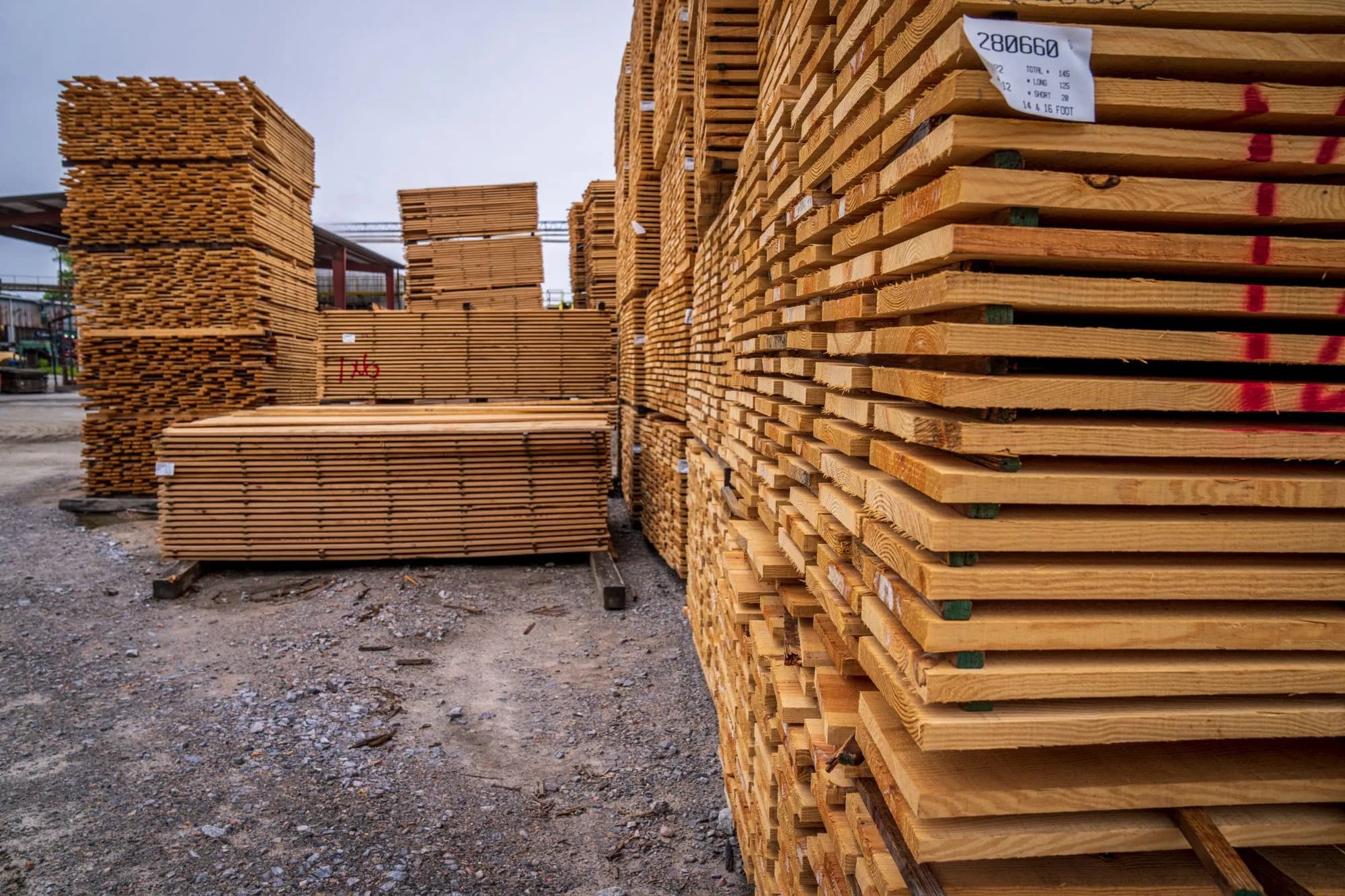
Every deck framing plan hits the same fork in the road: 2x8 vs 2x10 deck joists. Pick a 2x8 and you might need tighter spacing, or an extra beam, to hit your span. Pick a 2x10 and you get more reach for wider decks, but you pay more for the lumber and gain extra framing depth under the decking. Choosing 2x8 vs 2x10 deck joists comes down to your span, your budget, and how the deck ties into the house.
This guide lays out the actual span numbers, works through a real framing example, and flags exactly when it pays to upsize the joist rather than tighten the spacing.
TL;DR
- A 2x8 spans 11'10" at 16" o.c.; a 2x10 spans 14'0" at 16" o.c. (Southern Pine No.2, IRC Table R507.6)
- Dropping to 12" o.c. spacing stretches either size further, but adds joists, hangers, and labour
- 2x10 lumber typically costs more per linear foot than 2x8, and the gap is widening with 2026 lumber prices
- Bigger joists raise the framing depth under the decking, which can matter at door thresholds
- Run your actual span and spacing through the deck joist span calculator before you order lumber
2x8 vs 2x10 Deck Joists: The Full Size Comparison
Most framing decisions come down to four sizes: 2x6, 2x8, 2x10, and 2x12. Each one buys more span, at a cost in lumber, weight, and sometimes framing height. Below is a comparison for Southern Pine No.2 at 16 inches on-center, the spacing most builders default to. Treat the pricing column as a rule of thumb rather than a quote — costs swing by region and supplier, especially with 2026 tariffs still working through the supply chain.
| Size | Max span @16" o.c. | Approx. cost/lin ft* | Weight/lin ft | Typical use |
|---|---|---|---|---|
| 2x6 | 9'0" | $1.20-$1.60 | ~1.4 lb | Small platforms, low decks, short cantilevers |
| 2x8 | 11'10" | $1.70-$2.30 | ~2.0 lb | Standard mid-size decks, most residential projects |
| 2x10 | 14'0" | $2.30-$3.10 | ~2.6 lb | Larger decks, wide projections, fewer footings |
| 2x12 | 16'6" | $3.00-$4.00 | ~3.2 lb | Long spans, beams, stair stringers |
How Much Farther Can a 2x10 Span Than a 2x8?
At 16 inches on-center, a 2x10 spans 14'0" compared with 11'10" for a 2x8 — a difference of 2'2", or roughly 18% more reach. The pattern holds at other spacings too. At 12 inches on-center, a 2x8 reaches 13'1" while a 2x10 stretches to 16'2". At 24 inches on-center, the 2x8 drops to 9'8" and the 2x10 to 11'5". These figures come from our joist span guide and assume Southern Pine No.2 — Douglas Fir-Larch and Hem-Fir span slightly less at the same size, and cedar or redwood less again, so check your actual species with the joist span calculator.
For a deck projecting more than about 12 feet from the house, a 2x10 usually wins outright. You'd need to drop a 2x8 all the way to 12 inches on-center just to get close, meaning roughly 30% more joists, hangers, and screws for the same width of deck.
Worked Example: Framing a 14-Foot Deck Projection
Say you're framing a deck that projects 14 feet from the back of the house, running 20 feet wide. With Southern Pine No.2 at 16 inches on-center, a 2x10 spans exactly far enough — 14'0" — to reach across in one clear run, landing on a beam at the outer edge. A 2x8 can't get there at that spacing; its limit is 11'10", over two feet short. You'd either add a mid-span beam and a new line of footings, or tighten the joists to 12 inches, which only reaches 13'1" and still falls 11 inches short.
The 2x10 isn't just the tidier option here — it's the only one that clears the span in a single run without an extra beam. Framing that 20-foot width in 2x10 joists at 16 inches on-center needs roughly 16 joists. Forcing a 2x8 down to 12 inches would need around 21 joists, plus hangers and screws for each one, and it would still fall short of the required span. The extra cost of 2x10 lumber per foot is more than offset by not buying, hanging, and fastening five extra joists.
When Does Upsizing the Joist Beat Tightening the Spacing?
There are two ways to add capacity to a joist run: make the joists bigger, or pack them closer together. Which one costs less depends on how far short of the span you actually are. For more on the spacing side of that trade-off, see our comparison of 12 vs 16 vs 24 inch joist spacing.
- Short by only a few inches: tightening from 16" to 12" on a 2x8 usually costs less than upgrading every joist to 2x10, since you're only adding a handful of joists rather than paying a higher per-foot price across the whole run.
- Short by more than a foot: no amount of spacing tightening fixes it. A 2x8 at 12" o.c. still tops out at 13'1", so you need the bigger joist or an intermediate beam.
- Wide decks, 18 feet or more: upsizing to 2x10 usually wins on total cost, because fewer, bigger joists mean fewer hangers, less fastening labour, and a faster framing day.
- Narrow decks or small additions: 2x8 at 12" o.c. is often cheaper when the span allows it, since the material saving outweighs the labour of a few more joists.
How Are 2026 Lumber Prices Affecting the 2x8 vs 2x10 Decision?
Framing lumber isn't getting cheaper this year. The NAHB framing lumber price index was up 1.4% week-over-week in early July 2026, 4.7% for the month, and 5.1% year-over-year — the highest reading since August 2025, driven partly by softwood tariffs. That trend widens the price gap between 2x8 and 2x10 in dollar terms, even though the percentage difference between the two sizes stays roughly the same.
On a typical mid-size deck, framing entirely in 2x8 versus 2x10 might only differ by a few hundred dollars in lumber — small next to the $30-60 per square foot installed cost most homeowners are budgeting for the whole project. If your span genuinely needs the bigger joist, don't try to save money by undersizing it; that shows up later as bounce in the decking. Our guide to pressure-treated lumber prices in 2026 has a fuller picture of where costs are heading.
Does Joist Size Change the Framing Height at a Door Threshold?
Yes, and it catches people out more than you'd think. A 2x10 measures 9.25 inches deep; a 2x8 measures 7.25 inches. That difference sits directly under your decking, so it can push the finished deck surface up relative to an interior door threshold. Most jurisdictions want the deck surface within about an inch of the threshold, so on an attached deck with a fixed ledger height, swapping from 2x8 to 2x10 can force you to notch joists over the beam, drop the beam lower, or accept a small step down.
It's worth mocking up the framing height on paper, or running the numbers through the deck joist span calculator alongside the deck beam span calculator, before you cut a single joist — especially on an attached deck where the ledger board sets your starting point.
“We see more decks over-built with 2x10s out of habit than under-built with 2x8s out of ignorance. Match the joist to the actual span and spacing, not to whatever's stacked highest at the yard.”
Can I mix 2x8 and 2x10 joists on the same deck?
You can, but it's unusual outside a stepped or multi-level design. Mixing sizes on a single-level deck usually means mismatched framing heights, which complicates the decking installation. If part of the deck needs a longer span, it's more common to add a beam and keep one joist size throughout.
Is a 2x10 always stronger than a 2x8 at the same spacing?
Yes. At any given on-center spacing, a 2x10 both spans farther and carries more load than a 2x8 of the same species and grade, because it has more depth to resist bending. The trade-off is cost and framing height, not strength.
Do I need a permit either way?
Almost always, for an attached deck of any real size. Joist size is one line on the framing plan a building department checks against IRC Table R507.6. See our guide on whether you need a permit for what else gets reviewed.
What if my span calculator says I'm right on the limit?
Round down, not up. Span tables give maximum allowable spans, not comfortable ones, and deflection gets worse as you approach the limit. If your projection is within a few inches of a 2x8's max span, step up to 2x10 or tighten spacing rather than building to the edge of the table.
Working out 2x8 vs 2x10 deck joists isn't really a style choice — it's a span-and-budget calculation with a right answer for your project. Measure your actual projection, pick a spacing, and run both sizes through the numbers before you order lumber. Get the framing right first, and everything else on the deck has a solid base to sit on.
Size your deck to code, free
Put these numbers into the deck joist span calculator and get a code-compliant answer in seconds.
Open the Deck Joist Span calculator →